Best Power Banks in 2026: What the mAh Number Doesn't Tell You
The mAh rating on the box is never the capacity you actually get back into your phone — here's why, and what to check instead.
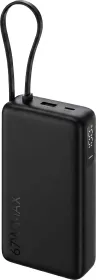
The rated capacity isn't the usable capacity
A 20,000mAh power bank never actually delivers 20,000mAh of usable charge into your phone. Converting voltage between the internal cell (typically 3.7V) and the USB output (5V or higher) causes energy loss, on top of the internal electronics' imperfect efficiency. The result: you generally get back around 60-70% of the rated capacity as real usable charge. It's not really a marketing trick — the mAh number just measures the raw cell capacity, not what actually reaches your device.
Output wattage matters as much as capacity
A huge capacity is pointless if charging is slow. Check the maximum output wattage and which fast-charging protocols are supported — USB Power Delivery (PD) for most recent phones and laptops, or Quick Charge for some older Android devices. A power bank delivering 65W or more over PD can charge a laptop, not just a phone, which completely changes how useful it is on the road. Also check that the advertised wattage applies to a specific port: some power banks have multiple ports but only hit peak output on one of them.
Passthrough charging, easy to overlook but genuinely handy
Passthrough charging lets the power bank itself recharge while simultaneously charging another device plugged into it — handy while traveling when only one outlet is available to charge multiple devices overnight. Not every power bank supports this, and some do it poorly (unstable or throttled charging on both devices at once). It's a feature you often only notice you need after not having it.
Airline carry-on limits and safety certifications
Airlines generally apply a 100Wh limit per power bank for carry-on without special approval (above that, airline authorization is often required, and very high-capacity units are typically banned outright). To convert mAh to Wh: multiply the mAh rating by the voltage (commonly 3.7V) and divide by 1000. A 20,000mAh power bank lands around 74Wh, under the usual limit. Also check for recognized safety certifications on the product — they indicate the battery has been tested against overheating and short-circuit risks, something that should never be an afterthought on a device you carry against your body all day.
To compare models that actually deliver on their claims, check our ranking of the best power banks.