TCL Q7D 75-inch Review: RGB Mini LED 4K TV
75-inch RGB Mini LED 4K TV with 144Hz, Dolby Vision and 2.1 sound: our review of the TCL Q7D.
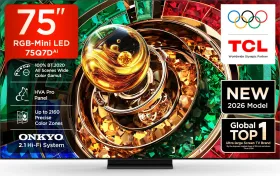
The TCL Q7D is a 75-inch 4K TV built around a Mini LED panel with RGB backlighting, a rarer approach than standard Mini LED that's meant to give finer zone-by-zone color control. On paper, the spec sheet is dense for this price bracket: a 144Hz refresh rate, HDR10, HDR10+, HLG and Dolby Vision support, a claimed 2000 nits of brightness, and a full Google TV platform. It's driven by TCL's own TSR AiPQ Processor and pairs with a 2.1 sound system tuned by Onkyo, subwoofer included. At 75 inches, it's clearly aimed at living rooms that want a large screen without paying OLED prices, while keeping a genuinely gaming-friendly feature set.
Quick summary
- 75-inch RGB Mini LED panel, 4K resolution (3840 x 2160)
- Native 144Hz refresh rate
- HDR10, HDR10+, HLG and Dolby Vision (plus Dolby Vision IQ)
- 4x HDMI 2.1 ports with eARC, ALLM, VRR and AMD FreeSync Premium Pro
- 2.1 sound system (20W + 20W subwoofer) tuned by Onkyo, Dolby Atmos and DTS Virtual X
- Google TV, Wi-Fi 6, Bluetooth 5.4, built-in Chromecast and AirPlay
- Listed price: around $1,807 / €1,667 / MAD 17,999
Strengths
- A large screen for the price of a smaller OLED: at 75 inches, it outsizes every OLED rival listed below (55 to 65 inches) at a comparable or lower price.
- A genuinely complete gaming spec sheet: 144Hz, HDMI 2.1, VRR, ALLM and Game Optimizer form a coherent set for current-gen consoles, rarely combined at this tier.
- Very broad HDR compatibility: HDR10, HDR10+, HLG and Dolby Vision are all supported, reducing the odds of a streaming source falling back to a lesser format.
- Sound hardware that goes beyond the bare minimum: the 2.1 setup with a dedicated subwoofer and Onkyo tuning is a step above the thin built-in speakers common on screens this size.
- An open smart TV ecosystem: Google TV, built-in Chromecast and AirPlay coexist, so you're not locked into a single device ecosystem.
Weaknesses
- Only 3GB of RAM and 64GB of storage: modest figures for an app-heavy Google TV interface, which can translate into sluggishness in daily use.
- High power draw in active use: 500W is a direct consequence of the screen size, but worth factoring into running costs.
- Mini LED, not OLED: unlike the OLED rivals below, it can't replicate true per-pixel contrast, since Mini LED backlighting still works in zones rather than individually lit pixels.
Who this is for
- Households that want the largest screen their budget allows without stepping up to OLED.
- Console gamers (PS5, Xbox Series) who'll actually use 144Hz, VRR and ALLM.
- Users who split time between Android and Apple devices, thanks to Chromecast and AirPlay both being built in.
- Buyers who want solid built-in sound before, or instead of, adding a soundbar.
Who should look elsewhere
- Picture purists chasing the native per-pixel contrast that only OLED panels deliver.
- Small living rooms: at 1670mm wide, the Q7D needs genuine viewing distance.
- Anyone planning to run a lot of third-party apps, given the 3GB of RAM on board.
- Shoppers hunting for the cheapest set on the market — this isn't an entry-level model.
Up against the competition
The TCL Q7D competes against smaller OLED sets. Here's how it stacks up on the shared data points available.
| Model | Price | Screen | Resolution | Panel / HDR | HDMI |
|---|---|---|---|---|---|
| TCL Q7D (75Q7D) | $1,807 | 75" | 4K | HDR10, HDR10+, HLG, Dolby Vision (RGB Mini LED) | 4 |
| LG B3 (OLED65B3PSA) | $2,048 | 65" | 4K | HDR10, HLG, Dolby Vision (OLED) | 2 (side) + 2 (rear) |
| Samsung S90D (QA55S90D) | $1,566 | 55" | 4K | HDR10, HDR10+, HLG (OLED) | 4 |
| Sony Bravia 7 (K-65XR70) | $2,494 | 65" | 4K | HDR10, HLG, Dolby Vision (Mini LED) | 4 (side) |
The TCL is the only set here to pass 65 inches, and it undercuts both the LG and the Sony on price. The Samsung S90D is the cheapest of the four but on a noticeably smaller 55-inch panel. The LG and Samsung, being OLED, rely on per-pixel contrast that the TCL's Mini LED backlight can't reproduce in the same way.
Our verdict: is it worth buying?
The TCL Q7D makes sense if you want a very large 4K screen with a genuinely strong gaming spec sheet (144Hz, HDMI 2.1, VRR) and above-average built-in sound, without paying OLED prices. Skip it if per-pixel OLED contrast is a hard requirement, or if your room can't comfortably fit a 75-inch screen.
Frequently asked questions
Does the TCL Q7D support Dolby Vision? Yes — the spec sheet lists HDR10, HDR10+, HLG and Dolby Vision, plus a Dolby Vision IQ feature.
How much power does the TV consume? 500W in active use and 0.5W in standby, according to the product spec sheet.
Is this TV good for gaming on a modern console? Yes: it offers 144Hz, HDMI 2.1, VRR, ALLM and a Game Optimizer mode, a combination built with current consoles in mind.
What's the difference between the TCL's RGB Mini LED and rivals' OLED panels? The TCL uses Mini LED backlighting with RGB zones, while the LG and Samsung models above use self-emissive OLED panels. These are different contrast technologies; our data can't compare their real-world picture quality, only their listed specs.
Is the built-in sound good enough, or do I need a soundbar? The spec sheet lists a 2.1 system (20W + 20W subwoofer) tuned by Onkyo with Dolby Atmos and DTS Virtual X, which is more capable than average. No listening-test data is available to confirm how it actually sounds.