Washing Machine Buying Guide 2026: What Capacity and Type to Choose?
Front-load or top-load, capacity in kilos, spin speed: a washing machine is a purchase you'll often keep for more than ten years. Here are the criteria that really matter before you invest.
🧺 Washing Machine Buying Guide for 2026
Unlike many electronic appliances, a washing machine typically stays in service for about ten years. In other words, a wrong choice stays with you for a long time — whether that's insufficient capacity for your household or needlessly high water and electricity consumption.
Here are the criteria that really separate a good purchase from a bad one.
Front-load or top-load?
This is the first decision to make, as it shapes both installation and everyday use.
Front-loading
The most common format, it generally allows for greater capacity and better washing and spinning performance. It can also fit under a countertop — a real advantage in a small kitchen or bathroom.
Top-loading
Narrower, it suits spaces tight on width. It also avoids having to bend down to load laundry, a real comfort for some users. On the other hand, it can't be installed under a countertop.
Capacity: don't judge by household size alone
Capacity in kilograms determines how much laundry you can wash per cycle. Getting this wrong leads either to washing too often or to wasting water and electricity on a half-full drum.
- 6 to 7 kg: suited to a single person or a couple.
- 8 to 9 kg: the most versatile size, suited to a family of 3-4.
- 10 kg and above: for large families or households that also wash bulky items (duvets, bedding).
Spin speed: a criterion that directly affects drying time
Spin speed, expressed in RPM, determines how much water remains in the laundry after the cycle. The higher it is, the drier the laundry comes out, cutting down air-drying time or time in the dryer.
A 1,000 RPM spin is fine for everyday use. Beyond 1,400 RPM, the gain mainly matters if you don't have a dryer and need laundry to dry quickly.
Semi-automatic or fully automatic?
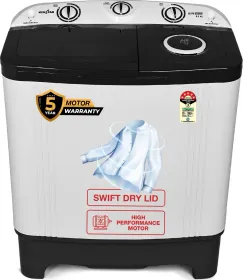
Semi-automatic models, still on the market at lower prices, require manual intervention between washing and spinning, often with two separate tubs. Fully automatic models handle the entire cycle without intervention, for noticeably greater everyday comfort, usually at a higher price.
Energy class and water consumption
A washing machine runs several times a week throughout its lifespan. Energy class and water use per cycle therefore have a significant cumulative impact on your bills, far more noticeable than for an occasionally used appliance.
Comparison table: which washing machine for your household?
| Profile | Recommended capacity | Suggested type |
|---|---|---|
| Single person / couple | 6-7 kg | Front or top load |
| Family of 3-4 | 8-9 kg | Front load |
| Large family | 10 kg and above | Front load |
| Small space, tight budget | 6-7 kg | Semi-automatic |
Mistakes to avoid
Underestimating the real capacity you need. A drum too small for your household leads to more frequent washing, which wears the machine out faster and increases total consumption.
Ignoring noise level. If the machine is near a living space, a loud spin cycle can become a daily annoyance — a criterion rarely highlighted but that affects real comfort.
Neglecting warranty and after-sales service. A washing machine is a long-term investment: the availability of spare parts and the responsiveness of after-sales support matter as much as the initial spec sheet.
Conclusion
The right washing machine is above all one whose capacity genuinely matches your household — neither too tight nor oversized. Once that's settled, favor a good energy class and a spin speed suited to your needs: these are the two elements that will make the difference on your bills and your comfort, cycle after cycle, throughout the machine's lifespan.